
AI Song from Lyrics: A Step-by-Step Guide
Learn how to make an AI song from lyrics: prep the text, generate and review the track, and disclose AI use before you share it.
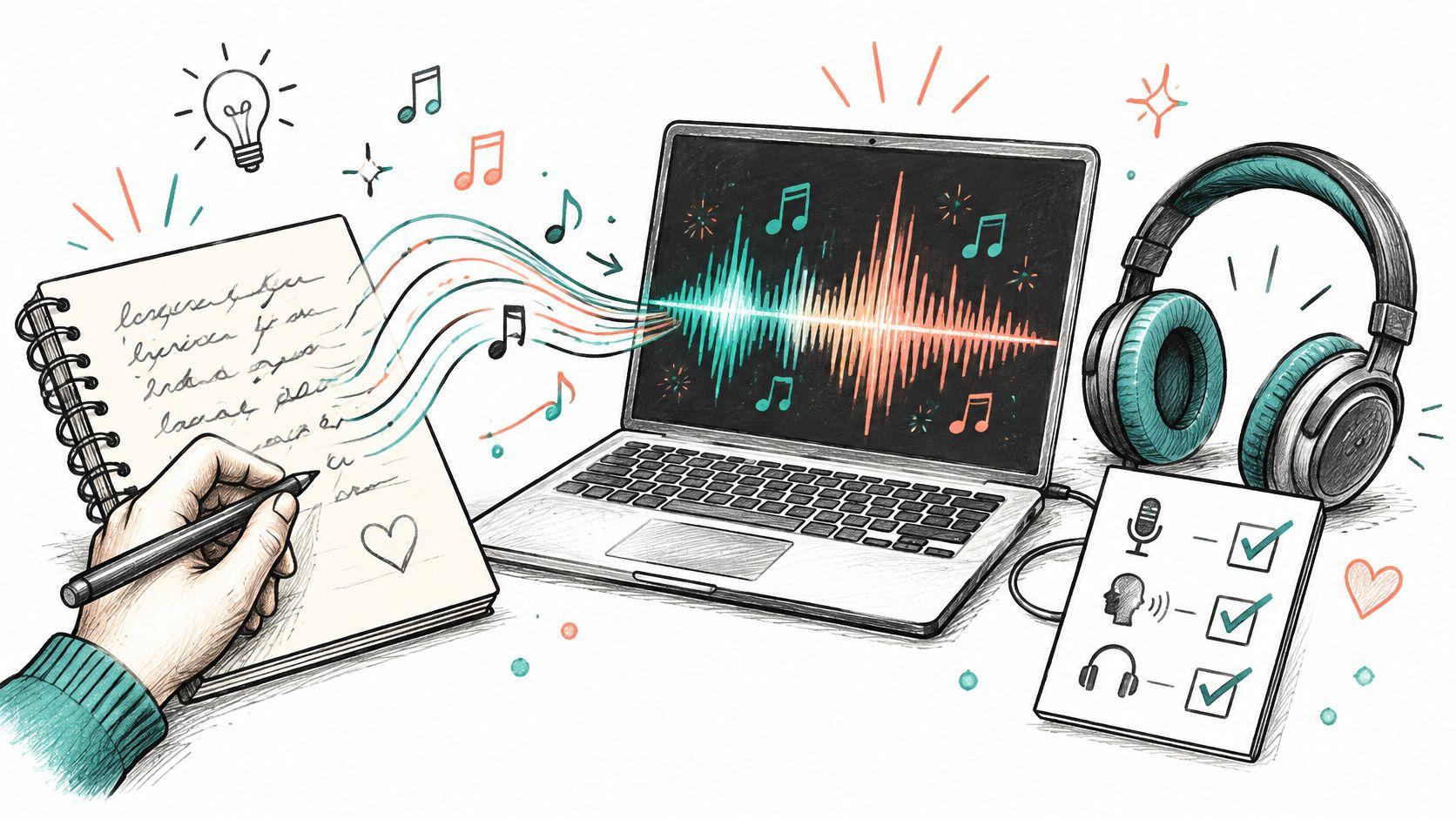
Your partner's anniversary is approaching, and you've got a page of memories but no melody. An AI tool can turn those words into a song, yet the first result might rush your favorite line, bury the punchline, or sing your partner's name incorrectly.
Making an AI song from lyrics works best when you treat the lyric sheet as a production brief, not just text to paste into a generator. Decide what must survive every take, then judge the audio against those requirements rather than accepting whichever version sounds most polished.
Table of Contents
- The Five-Stage Workflow at a Glance
- How to Shape Lyrics So a Voice Can Sing Them
- How to Generate Takes and Set the Style
- Reviewing the Finished Track Before You Use It
- Common Problems and How to Fix Them
- Disclosing AI Use and Copyright Before You Share
- Make It Yourself or Order One
The Five-Stage Workflow at a Glance
| Stage | What you do | What must be settled |
|---|---|---|
| Brief | Record the story, names, occasion, mood, and exclusions | What the song must say and leave out |
| Lyric shaping | Organize sections and balance phrase lengths | Words that sound natural when sung |
| Generate | Produce alternative takes from the approved lyric | A musical direction worth developing |
| Review | Check pronunciation, facts, clarity, and emotional tone | Whether the recording communicates the story |
| Fix and share | Repair failed passages and explain AI involvement | A presentable song with honest attribution |
Before opening Suno or another lyrics-to-song tool, settle these production choices:
- Genre and pace: Choose a recognizable direction, such as a relaxed acoustic ballad or an upbeat pop celebration.
- Vocal type: Specify a female voice, male voice, duet, or arrangement without vocals.
- Language: Identify the language of the performance and any names that need special pronunciation.
- Length and presentation: Decide whether you need a compact gift recording, a dance track, or something guests will sing along with.
- Nonnegotiable wording: Mark the actual names and personal phrases that must remain exact.
For a singalong presentation, consult MyKaraoke Video's Suno karaoke workflow before preparing the final playback materials. Decide whether you need karaoke early, but finish the song before building its presentation.
The lyric is the brief. Changing an awkward sentence before generation is simpler than trying to rescue it after the melody and vocal phrasing have formed around it.
The scale of production makes deliberate editing especially important: according to Deezer figures reported by France 24, AI-generated tracks rose from one in ten daily streamed tracks in January 2025 to more than one in three by November. That scale doesn't guarantee quality in an individual song. Your advantage is the specificity of the story and the care you take with it.
How to Shape Lyrics So a Voice Can Sing Them
A moving paragraph isn't necessarily a singable verse. Spoken sentences tolerate uneven length and complicated clauses; a melody needs room for stressed words, breaths, and a repeatable shape.
At Song Tailor, we start with the story, including names, how you met, the moments only you share, and a sound you like. Our guide to writing a custom song brief helps separate useful personal details from background information that doesn't need to become a lyric.
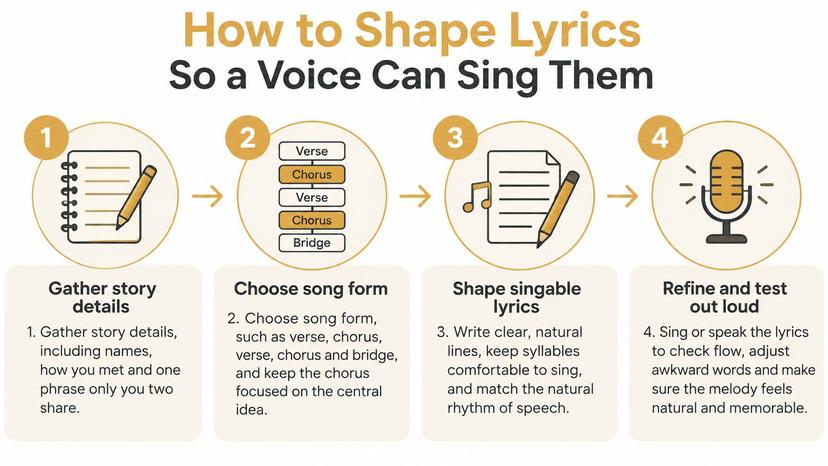
Shape the words before the melody
Collect concrete details. Include names, the place you met, an ordinary shared ritual, and a phrase the recipient will recognize. Record sensitive details separately so they don't accidentally enter the song.
Choose a form such as verse, chorus, verse, chorus, bridge. Give the chorus one central idea rather than making it summarize the whole relationship.
Balance phrase lengths. Compare lines that will occupy equivalent musical spaces. For example, replace We stayed awake in the kitchen until the morning light with We talked until the morning light. You lose a location, but gain breathing room. Keep the kitchen elsewhere if it's essential.
Speak the stresses before you sing them. A line like It was because of you that I came home can encourage emphasis on connecting words. Try Your voice brought me back home, where the meaningful words can carry the musical weight.
Choose meaning before rhyme. Don't force love, above, and dove into a story about repairing bicycles together. A recognizable image matters more than a perfect rhyme.
Add a pronunciation guide for unfamiliar names. For example, use SHIV-awn as a working rendering of Siobhan, then confirm it with the person who knows the intended pronunciation. Preserve the correct spelling on the presentation lyric sheet.
Read aloud at an unhurried speaking pace. Rewrite consonant-heavy combinations that make you stumble before asking a synthetic singer to handle them.
Reject strained phrasing early
The lyrics-to-melody paper on arXiv identifies word-to-note alignment and note duration as central to singability, and describes limitations in line-level generation and precise syllable control. Where a tool accepts timing or phrase constraints, use them rather than supplying an undivided paragraph.
Production gate: Reject a line that needs repeated syllable squeezing, unnatural vowel stretching, or emphasis on a weak connecting word.
Don't polish every line in isolation. Read the entire song aloud so the verses develop the story and the chorus still feels like its emotional center.
How to Generate Takes and Set the Style
A useful style prompt describes a recording you could arrange, not a performer you want to copy. Compare these approaches:
| Weak direction | More useful direction |
|---|---|
| Make it emotional and exactly like my favorite singer | Warm acoustic folk ballad, relaxed pace, fingerpicked guitar, restrained piano, intimate lower-register vocal |
| Huge romantic song with everything | Gentle piano-led love song, clear lead vocal, light strings entering at the chorus, understated ending |
The more useful prompts establish priorities. They don't ask the system to reconcile competing moods or reproduce someone's identity.
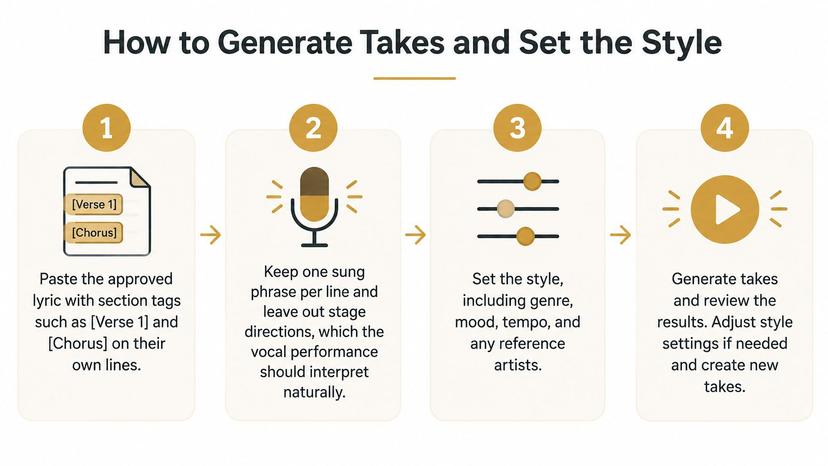
Keep the generation test controlled
Paste the approved lyric. Put section tags such as
[Verse],[Chorus], and[Bridge]on separate lines. At Song Tailor, customers approve the lyrics before we produce any song.Keep one intended sung phrase on each line. Put production instructions in the style field, not among the words the voice should sing.
Describe genre, pace, instruments, vocal character, and mood. For rhythm-focused experiments, Drumloop AI prompting best practices is a useful companion when organizing prompt details. Keep the directions relevant to the tool you're using.
Avoid requesting a living artist's voice or signature sound. Describe the musical qualities you want instead.
Generate alternative takes without changing the approved text. Listen for the best delivery of the story, not merely the most dramatic opening.
Change one variable at a time. Compare piano alone against piano with light strings while holding everything else steady. If you rewrite the lyric and change the arrangement together, you won't know which change helped.
Label files by revision and difference, such as piano only or lighter chorus. Record the failure beside each rejected take.
Set an imitation boundary
In a UK survey of more than 1,750 music consumers, 78.5% believed artists' music or vocals shouldn't be used by AI without permission, according to Music Week's coverage of the BPI survey. Describing instrumentation and vocal range avoids making impersonation the creative objective, though it doesn't settle every training-data or rights question.
You can listen to our full song samples to identify useful vocabulary for arrangement and vocal presentation. If your submitted lyric closely resembles an existing song, replace the borrowed expression rather than treating a different accompaniment as a cure.
From $39 · Premium & Event Grade delivered within 1 hour · 100% money-back guarantee
Reviewing the Finished Track Before You Use It
One study reported that only 30.90% of AI-generated songs closely resembled human-written examples, as described in the NLP for Music and Audio paper. That's a finding about the study's outputs, not a predicted failure rate for your chosen generator. It supports a practical principle: fluent lyrics and convincing sound aren't enough to approve a recording.
A first take is a candidate, not an automatic final. It might pass unchanged, but it should earn approval through the same checks as a revised version.
Review checks and pass standards
Use the following as a production scorecard. The numerical cutoffs are suggested acceptance rules, not claims about a tool's performance.
| Check | What to listen for | Pass standard |
|---|---|---|
| Names and facts | Every name, date, and place is sung correctly | Zero errors |
| Intelligibility | Each line understood on first listen | Score of 4 or higher |
| Singability | No squeezed syllables or stretched vowels | No line flagged on second listen |
| Emotional fit | Tone matches the occasion and relationship | Score of 4 or higher |
| Phone speaker clarity | Vocal stays clear over the instrumental | Lyrics audible at low volume |
| Structure | Chorus returns consistently and the ending lands | Matches the lyric sheet |
Score lyric relevance, factual accuracy, singability, vocal intelligibility, musical coherence, and emotional fit using a consistent scale from poor to excellent. Don't let a strong arrangement compensate for an incorrect memory.
Listen without helping the recording
Start on headphones with the lyric sheet closed. Ask whether the story makes sense and whether the delivery suits the relationship. A memorial song can be technically smooth yet feel wrong if the performance turns theatrical.
Next, use a phone speaker at a comfortable low volume. Check whether the accompaniment masks important words, particularly at the chorus. Then open the lyric sheet, follow every line, and timestamp omissions, substitutions, and pronunciation problems.
A beautiful take with the wrong name is an unfinished take.
If possible, ask someone who hasn't watched the editing process to listen without the text. You already know what each unclear phrase is supposed to mean, so you're poorly placed to judge its first-listen clarity alone.
A recording that passes every check is ready for approval. Any failed name or fact check blocks sharing, regardless of its other scores.
Common Problems and How to Fix Them
A mispronounced name deserves attention before cosmetic production changes. The vocal system may interpret an unfamiliar spelling differently from the family, and adding pronounce correctly to the style prompt doesn't tell it what sound you need.
Use a phonetic working spelling, place it in a natural phrase, and regenerate the affected passage. Listen to the whole phrase afterward, because changing a name can also change the surrounding rhythm.
Symptoms, causes and fixes
| Symptom | Likely cause | Fix |
|---|---|---|
| Name sung wrong | Vocal system guesses the pronunciation of a proper noun | Respell phonetically in the lyric and re-render the section |
| Chorus words rushed | Too many syllables for the line length | Cut a word or split the line into shorter phrases |
| Vowels stretched oddly | Word duration doesn't fit the melodic space | Swap the word, shorten the held note, or move the stressed syllable onto a suitable note |
| Verses sound identical | Style description is too vague about development | Specify pace, main instrument, vocal type, and a change in verse arrangement |
| Rhymes feel forced | Rhyme chosen before meaning | Rewrite around a concrete image and let a less important line carry the rhyme |
| Song drifts from brief | Brief lists competing moods or too many details | Keep a clear emotional direction and one central memory |
Diagnose before regenerating
A rushed chorus can have different causes. If the same phrase collapses in every take, edit the lyric; if it works in one performance but not another, the musical setting may be responsible. Those problems require different fixes.
Revision rule: Set a small retry budget for unchanged lyrics. When the same defect persists, change the input instead of buying another chance at the same result.
Avoid an arbitrary regeneration target when the cause is already obvious. A long clause that repeatedly overruns its musical space needs fewer words, not more enthusiasm in the prompt.
A single-word correction may require regenerating a whole phrase or section. Keep unaffected material locked where the tool permits, then inspect the join for abrupt changes in room sound, vocal character, accompaniment, or loudness.
If your tool can't replace sections reliably, weigh the correction against the cost of losing a strong performance elsewhere. Save the earlier version before testing, and never overwrite the only copy of a promising take.
Disclosing AI Use and Copyright Before You Share
AI involvement isn't a secret you need to hide to preserve a gift's meaning. The honest distinction is between the personal contribution you made and the production work a tool performed.
Keep that distinction visible when thinking about ownership:
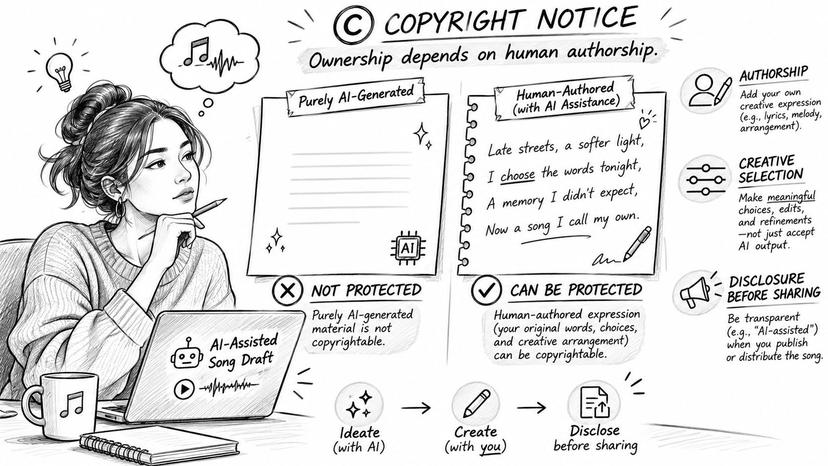
The U.S. Copyright Office's explanation of AI copyrightability states that purely AI-generated material isn't protected, while qualifying human-authored expression, including creative selection, arrangement, or modification, can be. Merely prompting a system generally doesn't establish authorship.
Your original lyric wording may therefore warrant different treatment from generated music or vocals. Keep dated drafts and a record of substantive edits, but don't assume that approving an output gives you copyright in every part.
Use a practical disclosure checklist
- Identify AI's role: Say whether it drafted the lyrics, composed the music, generated the vocals, or assisted with editing.
- Describe human involvement accurately: Distinguish writing from selecting or revising, and only claim pronunciation review if someone performed it.
- Decide where it will go: Separate a private gift from public distribution. Before publishing, check the platform's disclosure requirements and your generator's usage terms.
At Song Tailor, AI tools write lyrics from the customer's story, and music and vocals are made after lyric approval. That process shouldn't be described as personally writing every word or hiring a human singer.
For a card, adapt wording such as this:
I shaped this song around our memories and used AI tools to create the music and vocals.
If you wrote the words yourself, say so. If a person recorded the vocal, make that distinction too.
For additional context alongside the written guidance:
Private sharing limits the audience, but it doesn't grant permission to imitate someone's voice. Transparency should explain the process without making ownership or consent claims you can't support.
Make It Yourself or Order One
The decision comes down to four things: deadline, how much control you want over individual lines, whether you can check the audio critically, and how many songs you need. A service takes production work off your plate, but no generator or service knows whether a private memory is accurate. That part only works if you supply the details and approve the words.
Which path fits your situation
| Situation | Better fit | Why |
|---|---|---|
| Several weeks ahead, enjoy the process | Make it yourself | Direct control over wording and arrangement, with spending limited by your chosen tool |
| Short deadline, need a polished result | Service | Delivery is scheduled from lyric approval |
| Family name must be sung exactly | Service with human review, or yourself with phonetic checks | Someone must verify the intended pronunciation against the recording |
| Songs for several different recipients | Service, ordered one song at a time | Orders use one-time payments, so each recipient's song is a separate purchase |
Making it yourself suits people who enjoy revision. You can test unusual structures, swap instrumentation, and reject a technically clean take that does not feel personal. Plan to spend your attention on listening and file management, because pressing Generate is the fast part.
A service fits when managing drafts and audio takes would distract from the occasion. For a wedding, memorial, or public presentation, pick a process with named review responsibilities rather than assuming payment prevents errors. The songwriter-for-hire guide helps you compare the work you want to keep with the work you want handled.
Compare delivery and review carefully
Song Tailor's Quick Gift costs $39 USD and includes a song written from your story, an MP3, the full lyrics, and a private reveal page, with delivery within 48 hours after lyric approval. Premium Keepsake costs $89 USD, delivers within one hour after approval, and adds human producer review immediately after delivery covering tone, names, pronunciation, and lyric clarity. Event Grade starts at $149 USD and includes the same post-delivery human review along with four studio takes.
Song Tailor uses AI tools for the lyrics, music, and vocals. Delivery times run from lyric approval, not from the moment you start writing your story, so leave room to read the draft, edit individual lines, or ask for a fresh version before you approve it.
Whichever path you choose, make the next steps concrete:
- Submit the story and approve the lyric. Resolve sensitive details and exact wording, including how each name should sound, before production starts.
- Listen on phone speakers. Check the actual sung words against the lyric page, since a clean vocal can still bend a name.
- Prepare disclosure wording and playback. A reveal link plays in a phone browser with no app or account, but confirm the recipient can open it before the moment.
Song Tailor turns your story into AI-assisted lyrics, music, and vocals, with lyric approval before production and a private reveal page for sharing the finished song. Visit Song Tailor to start with your recipient's name, a meaningful memory, and the sound you want, then review the words before they become a recording.
Ready to make yours
The brief takes five minutes. The song lasts forever.
Tell us about your person: the names, the memories, the things only you know.
From $39 · Quick Gift in 48 hours, Premium & Event Grade within 1 hour of lyric approval · 100% money-back guarantee: we review every request individually and may offer a revision or a full or partial refund