
Personalized Kids Music: How Custom Songs Are Made
Personalized kids music explained: how custom songs are made, what details to include, and the occasions where they make meaningful gifts.
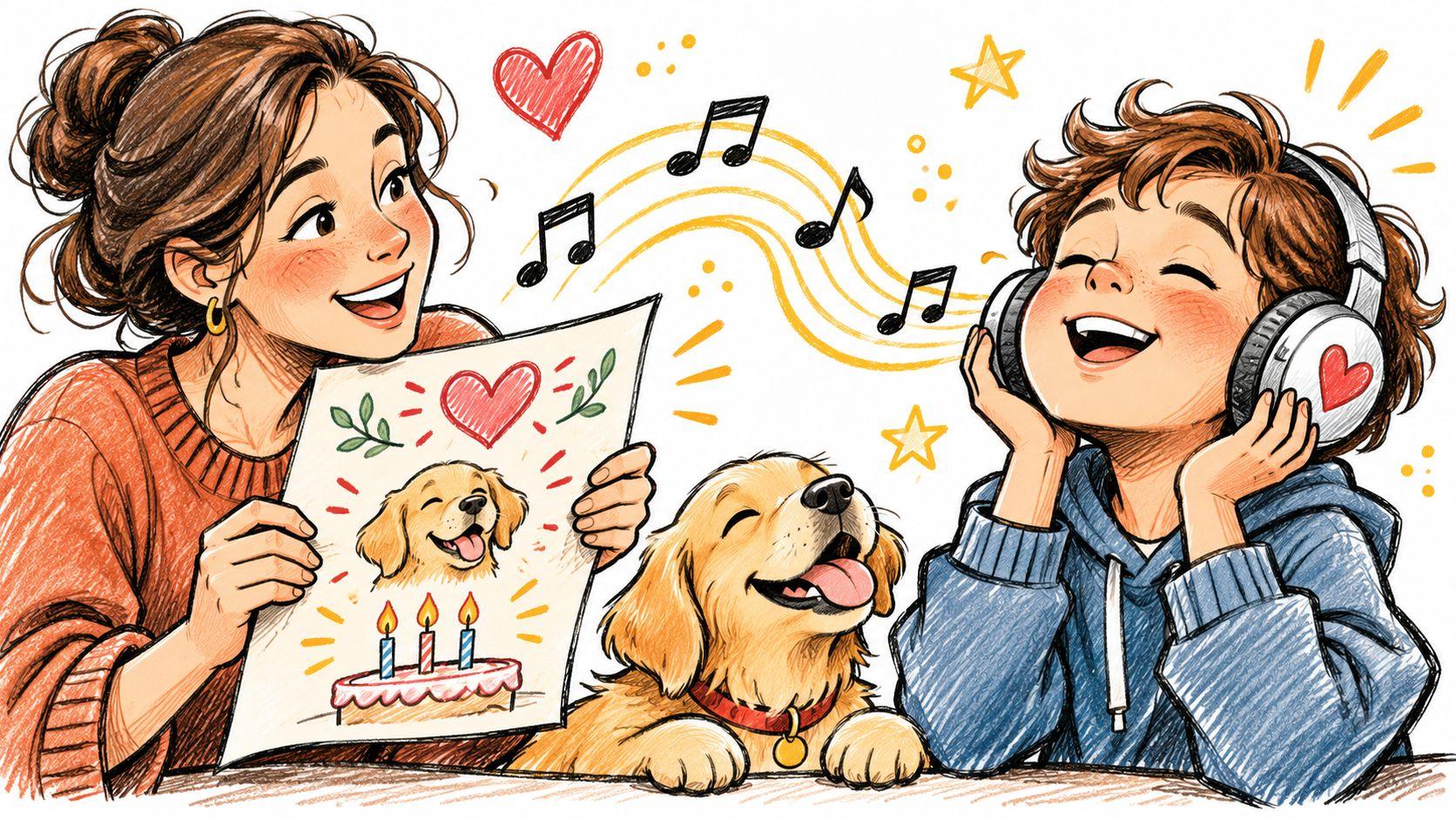
Your child sings the same favorite song from the back seat, complete with the pauses and sound effects. You're considering a song that includes their own name, their dog, or a family memory, but you're wondering whether it will feel meaningful or just sound like a novelty gift. You may also be unsure which details to share, what sound to choose, and whether your child will enjoy hearing it.
The best starting point isn't the gift presentation. It's the child's experience of listening: what they'll recognize, how the music will feel, and whether they can join in comfortably.
Table of Contents
- What Personalized Kids Music Really Is
- What to Include and What to Keep Private
- How a Custom Song Is Made Step by Step
- Matching Tempo and Lyrics to Your Child's Age
- Occasions Where a Custom Song Makes a Meaningful Gift
- Adapting Songs for Children With Sensory or Communication Needs
- Confirm Your Brief Before You Order a Song
What Personalized Kids Music Really Is
Say a four-year-old knows every word of a song about herself and her dog. She waits for the line about his muddy paws, then sings her name before the vocalist does. The personal connection comes from a recognizable little story, not just from hearing her name.
Personalized kids music is an original song built around a specific child or family story, with an intended occasion, a chosen mood, and words the buyer should have an opportunity to review.
A playlist is like off-the-rack clothing: you choose something that roughly fits. A custom song is closer to a made-to-measure outfit, shaped around the recipient's details and preferences. That doesn't make it better than their favorite everyday music. It gives it a different purpose.
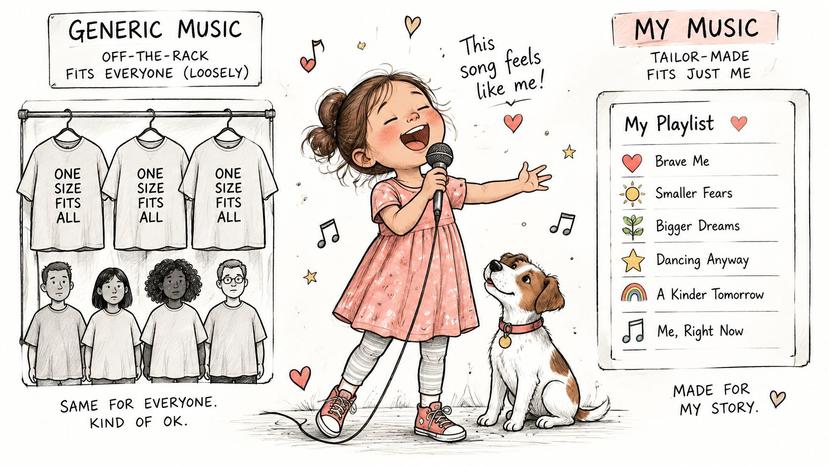
The words, sound, and presentation
Personalization has several layers, and each changes a different part of the experience:
- The words change what the song says. A nickname, a remembered adventure, or a family joke gives the child something recognizable.
- The sound changes how it feels. Tempo, singing voice, instruments, and the amount of musical activity affect whether it suits a party or a quiet cuddle.
- The presentation changes how the child meets it. A printed lyric sheet invites shared reading, while an MP3 or private reveal page makes playback convenient.
For the child-and-dog example, the words might describe splashing through puddles. The arrangement could be playful without being noisy. A grown-up could introduce it during a familiar family listening moment rather than making the child perform for an audience.
A generic track with a name inserted offers a narrower kind of customization. For a story-led song, the important question is whether the details shape the meaning, not merely whether the name appears.
Starting point: Decide what the song should say, how it should sound, and how your child will first hear it.
What to Include and What to Keep Private
A few vivid, non-identifying memories make a better starting point than a full biography. A pancake flipped onto the floor can become a funny verse. A list of schools, relatives, addresses, and activities mostly gives the writer more information to sort through.
Choose details that reveal personality without revealing location or vulnerability. A favorite animal, an invented superhero name, or a shared bedtime joke can make the words feel familiar without identifying where a child spends their day.
The privacy-conscious approach described by LittleTunes favors a first name or nickname, a broad activity, and a mood rather than school details, addresses, exact routines, or medical information. Treat that as a sensible information-minimization principle, not a guarantee about any service's storage practices.
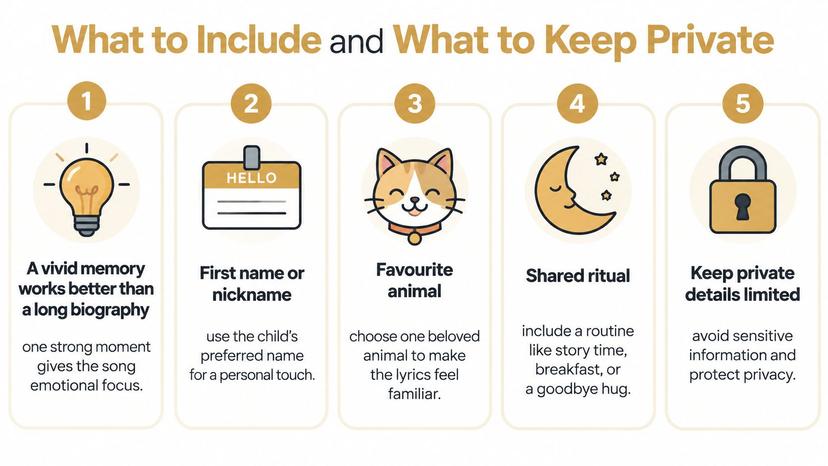
Give the writer meaning, not a dossier
Consider the difference between describing a child's love of walking the dog and supplying the route, departure time, and home address. The first gives the writer a usable scene. The second adds identifying information without improving the emotional center.
Use these boundaries when preparing your story:
- Useful starting details: A preferred first name or nickname, a beloved animal, an imaginary adventure, or a shared activity such as making pancakes.
- Details to leave out: School names, home addresses, exact schedules, medical history, and other children's full names.
- Audio to handle cautiously: Identifiable recordings of the child's voice, particularly when retention and deletion arrangements aren't clear.
You don't need to upload a child's voice just to communicate pronunciation. A written pronunciation guide may be enough. If audio is necessary, understand its purpose and handling before sending it.
Clarify storage and sharing
Before submitting personal material, get clear answers about whether stories and audio are retained, how long they're kept, and how deletion works. Also establish who can open a reveal page and whether someone with access can forward it.
Our reveal pages use unguessable links and aren't indexed by search engines. That limits casual discovery, but it doesn't stop a recipient from passing a link to somebody else.
From $39 · Premium & Event Grade delivered within 1 hour · 100% money-back guarantee
Include only details you'd be comfortable having forwarded beyond the intended audience.
Your practical template is simple: preferred name, broad interest, shared memory, intended feeling. Leave identifying details out unless they're necessary and you understand how they'll be handled.
How a Custom Song Is Made Step by Step
A useful custom-song workflow follows a clear path from story to finished audio. The buyer shouldn't need musical training, but they do need opportunities to check meaning, wording, and pronunciation.
Our guide to how the process works explains the workflow. We use AI tools for lyrics, music, and vocals, with music production beginning after the customer approves the words.
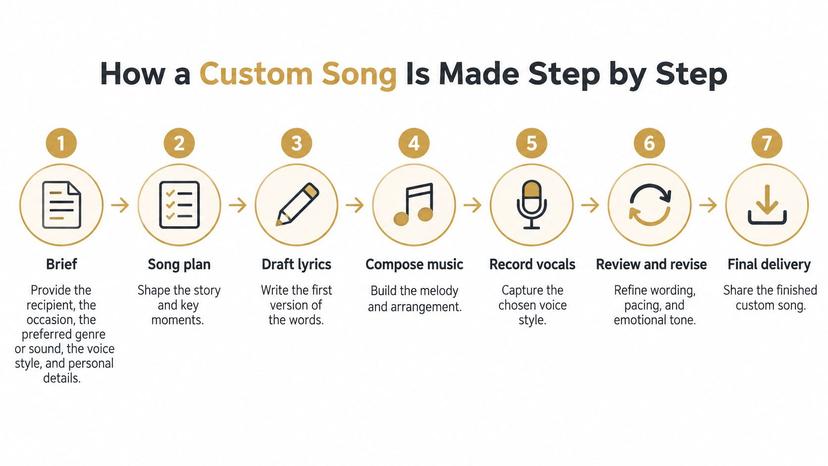
From the story to approved words
Complete the brief. Describe the recipient, occasion, preferred sound, voice style, relevant memories, and anything to exclude. Exclusions matter because an affectionate family joke may still embarrass the child when sung aloud.
Shape the lyric draft. The writer turns the material into a central idea, verses, and a chorus before the music is produced. A focused draft should sound like a song about this child, not a checklist of everything the family submitted.
Review the words carefully. Read the draft aloud, checking names, relationships, tone, and whether the child would understand the language. In our workflow, customers can edit individual lines or request a fresh draft before approving the text.
This is the easiest point to remove a boastful line, correct a mistaken memory, or replace an awkward word. Don't approve a phrase because it rhymes. Once it's attached to melody and vocals, changing it may require new production.
From approved words to listening
Produce the music and vocals. The approved text transforms into a melody, arrangement, and vocal performance in the requested style. Requests for gentle singing and sparse accompaniment must be audible, not just instructions on a form.
Check the finished performance. Listen for name pronunciation, intelligibility, unexpected emphasis, and whether the emotional tone fits. Review arrangements differ, so establish whether human review happens before or after delivery rather than assuming it's included at every level.
Receive the files and lyrics. Save the audio and check that the accompanying text matches the performance. Test playback on the device you'll use for the reveal, not only on headphones.
Choose how to share it. Decide whether the first listen belongs in a quiet room, at a celebration, or alongside a printed lyric sheet. Let the child enjoy the song without requiring an immediate reaction.
There's no supported universal timetable for each production stage. Allow time for your own lyric review, and check when the delivery clock starts; a production promise after approval doesn't include time spent deciding on the words.
Your strongest control points are the brief, lyric approval, and sharing choice. The provider handles drafting, production, quality checks, and delivery, so spend your attention where you can most directly shape the result.
Matching Tempo and Lyrics to Your Child's Age
Children don't all interpret musical mood in the same way. In a developmental experiment using 32 manipulated musical excerpts, children aged 3–4 didn't reliably distinguish happy from sad music, 5-year-olds responded to tempo changes but not mode changes, and children aged 6–8 responded to both tempo and mode.
Tempo means the pace of the music. Mode refers here to major or minor organization, often associated with contrasting moods. For younger listeners, don't assume that a minor-key melody alone will communicate sadness or that a major-key melody will communicate happiness.
Tempo and lyric guidance by age band
The developmental findings support the emotional-cue column below. The vocal and lyric choices are practical starting points, not tested prescriptions for every child.
| Age band | Reliable emotional cue | Tempo and vocal approach | Lyric approach |
|---|---|---|---|
| Ages 3–4 | No reliable happy/sad distinction in the experiment; don't rely on mode alone | Clearly contrasting pace; warm, unhurried delivery for calm listening | Short spoken-style name line and a repeated central phrase |
| Age 5 | Tempo changes, not mode changes | Lively for celebration; slower for bedtime | Central memory in the chorus, with simple verses |
| Ages 6–8 | Both tempo and major or minor mode | Mode can add a secondary mood cue alongside tempo | A short story in fuller verses, keeping important words clear |
| Ages 9–12 | Open question in this experiment | Judge a short sample against the child's existing preferences | Check vocabulary and lyric density with the child where possible |
The youngest group needs particular caution: the experiment doesn't establish that tempo reliably communicated happy versus sad feelings for them. Clear pacing remains a useful production choice, but the child's response matters more than an assumed emotional label.
For older children outside the experiment's age range, don't extrapolate a precise rule. Use a sample, familiar listening preferences, and the child's own opinion.
Make the important words easy to hear
Musical engagement doesn't automatically mean accurate word learning. A Cambridge-published study of 32 children aged approximately 47–50 months found better learning of novel object names in spoken sentences than in songs with an unfamiliar melody.
That finding doesn't mean songs are unsuitable for children. It means clarity deserves priority when recognition or learning matters.
Put the child's name and central memory in short, rhythmically clear phrases. Avoid stretching a key word across elaborate runs of notes or burying it beneath busy accompaniment. A line the child can comfortably say is a useful starting point for a line they may want to sing.
Occasions Where a Custom Song Makes a Meaningful Gift
The occasion sets the song's job: celebrate, welcome, reassure, or remember. Choose that job before choosing a genre.
A birthday song can invite movement and laughter. A pet memorial needs a different kind of attention, with gentle language and space for the child to listen without joining in. Neither needs to summarize the child's entire life.
Occasion, tone and key content for custom songs
These are suggested design choices, not promises about how a child will respond.
| Occasion | Tempo and mood | Detail to feature | Best moment to play |
|---|---|---|---|
| Birthday | Fast, upbeat | A memory from this year and the child's name in the chorus | Party or cake moment |
| Graduation or school milestone | Medium, proud | Effort and growth, not only results | Family celebration dinner |
| New baby or welcome | Slow, gentle | Family hopes and a short lullaby-style chorus | Bedtime or a quiet family gathering |
| Bedtime or sleep routine | Slow, calm | A repeated calming line the child can join | Nightly routine |
| Transition such as a new school or home | Steady, reassuring | A predictable chorus with a reassuring message | A calm morning before leaving |
| Christmas or holiday | Festive, bright | Family jokes and shared traditions | Holiday gathering |
| Mother's Day or Father's Day | Warm, medium | A shared memory from the child's perspective | Breakfast or card moment |
| Memorial for a pet or grandparent | Slow, tender | Gentle memories without graphic details | Quiet family remembrance |
Match the listening moment, not just the label
Celebrations often suit a brighter pace and a concrete recent memory. Still, upbeat doesn't have to mean loud: a child who dislikes crowded parties may prefer a playful song at home.
Comfort-focused occasions call for restraint. A welcome song can express hopes without making grand predictions about who a baby will become. For ideas about that balance, our new-baby song gift guide focuses on the family welcome rather than a detailed biography.
A transition song should acknowledge uncertainty without promising that everything will be easy. For remembrance, invite memories rather than prescribing feelings. A child may want to laugh about a pet's habits, feel sad, or stop listening.
Other milestones fit the same decision process. A grandparent's retirement might call for shared family gratitude; a first activity might suit encouragement. For an employee's children, keep participation optional and let the parent choose what information to contribute.
Choose the occasion, then the intended energy, then the words. A lively lyric won't turn a sleepy arrangement into a party song.
Adapting Songs for Children With Sensory or Communication Needs
Consider a child who covers their ears when a fast song starts but happily returns to a quiet, familiar tune. Adding their name to the loud track won't make it a better fit. Personalization must include how the child experiences sound, not only what the lyrics mention.
Start with observable preferences. Describe soft singing, a steady pulse, fewer instruments, or an ending without a sudden flourish. Those instructions tell a producer more about the desired result than a medical label alone.
Make participation optional and accessible
Useful adaptations to consider include:
- A calmer arrangement: Request fewer simultaneous layers, restrained percussion, and no abrupt changes in volume.
- The right amount of repetition: Some children enjoy a returning phrase; others prefer a shorter version without repeated choruses.
- Predictable structure: Ask for recognizable verse-and-chorus sections and a clear ending.
- Accessible response space: Leave pauses for a spoken word, gesture, sound, communication device, or no response at all.
- Visual support: Pair a lyric sheet with simple family-chosen cues for important actions or phrases.
- Alternative listening versions: Consider a quieter or simpler version if the production arrangement allows it.
Call-and-response shouldn't become a test. The child can listen, move, point, or decline, and the experience can still be meaningful.
Accessibility isn't a treatment claim
Inclusive-music work published by Springer explores assistive routes such as gaze control, motion tracking, and tactile interfaces, alongside rehabilitation work testing an AI-driven virtual music teacher for young children with cerebral palsy. This work concerns access and participation; it doesn't establish that a consumer custom song produces therapeutic benefits.
A personalized song is not therapy, diagnosis, or a substitute for an occupational or music therapist. If you want to use music toward a clinical goal, involve the professional who supports the child.
For a family gift, describe what the child enjoys and what they want to avoid. Offer a choice between suitable sounds where possible, and respect a decision not to listen. Dignity means making room for their preferences, not turning their diagnosis into the song's defining subject.
Confirm Your Brief Before You Order a Song
A personalized song is a good fit when it has a clear emotional purpose, a meaningful listening moment, and a small amount of suitable family material. It's a weaker choice when the planned reveal is likely to overwhelm the child or when someone expects it to replace professional support.
Write a brief that a producer can act on. Our guide to writing a custom-song brief can help you turn memories into clear instructions.
Check the essentials before paying
- Recipient and occasion: Explain who will hear the song and why you're making it.
- Mood and sound: Describe the preferred energy, voice, and arrangement in ordinary language.
- Personal material: Select a focused memory and meaningful detail rather than a life history.
- Exclusions: Identify words, topics, sounds, or jokes that shouldn't appear.
- Review and handling: Resolve storage, deletion, sharing access, revision terms, and the timing of human review.
We include a song written and produced from your story, an MP3 download, full lyrics, and a private reveal page with every order. Quick Gift costs $39 and includes approval of the lyric before the song is made, with no producer review or included revision. Premium Keepsake costs $89, delivers within one hour after lyric approval, and includes human producer review immediately after delivery, a printable lyric sheet, and one free guided revision.
That review timing matters: don't assume a human has checked the recording before its initial delivery. Leave yourself room to listen privately before presenting it to the child.
Start by listing a few memories, then choose the occasion and preferred tempo. Request the lyric draft, read it aloud, and approve it only when the words feel right for the child who'll hear them.
Song Tailor turns your family story into an original song with downloadable audio, full lyrics, and a private reveal page. Visit Song Tailor to begin with your child's preferred sound, a meaningful memory, and clear instructions about what to leave out.
Ready to make yours
The brief takes five minutes. The song lasts forever.
Tell us about your person: the names, the memories, the things only you know.
From $39 · Quick Gift in 48 hours, Premium & Event Grade within 1 hour of lyric approval · 100% money-back guarantee: we review every request individually and may offer a revision or a full or partial refund